Guides
Childcare center equipment checklist: sizing the first order
A childcare center equipment checklist sized to your licensed head counts: how many cribs, cots and seats to buy, which spares to add, and what can wait.
What to take away
- Size the order from the head counts on the license, not from the building's capacity.
- Infant, toddler and preschool rooms need different furniture, different seat heights and different counts, so each room gets its own line.
- Add spares only where items rotate through damage, cleaning or wear: cribs and nap cots.
- Price the counts with freight, assembly and the first year of replacement parts, because the catalog price is not the budget.
- Every item needs a named owner, a purchase date and a warranty file before it enters the room.
- Confirm current requirements with your state licensing authority. Rules differ by state, program type and ages served.
Start from the licensed counts
Buy to the counts on your license, not to the building's capacity. A 40-child center licensed for 8 infants, 12 toddlers and 20 preschoolers sizes each room on its own, because each age group needs different furniture, seat heights and numbers.
First Purchase by the Numbers
- 8Infants licensed
- 12Toddlers licensed
- 20Preschoolers licensed
- 36Cots needed with 10% spares
| Item | Infant (8) | Toddler (12) | Preschool (20) | How the count is set |
|---|---|---|---|---|
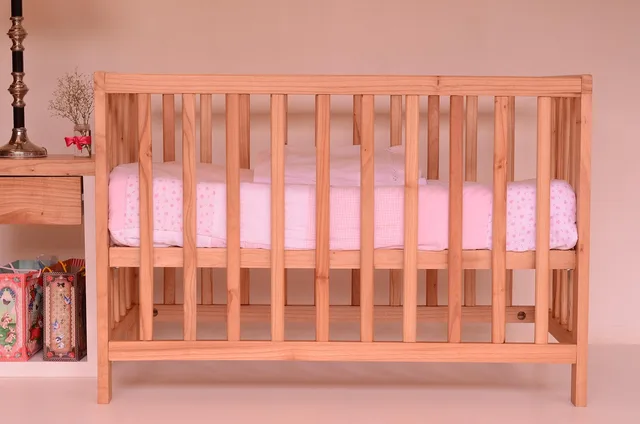
| Cribs | 10 | none | none | One per infant, plus two spares for damage and cleaning rotation |
| Changing tables | 1 | 1 | none | One for the infant room, one shared by the toddler room |
| Nap cots | none | 12 | 20 | One per napping child, plus 10 percent for wear, about 36 |
| Child-size seats | none | 12 | 20 | One seat per child at each age group |
| Cubbies | none | none | 20 | One per child, with storage children can reach without climbing |
Seat heights differ by group. Toddler chairs usually sit 5 to 9 inches high, preschool chairs 11 to 13, and suppliers publish the height of every chair they sell. Toddler rooms also need their own changing area, separate from the infant room.
Price the counts
Multiply each count by your supplier's unit price, then add freight, assembly and the first year of replacement parts. At typical 2026 school-supply prices, the furniture basket for the 40-child example lands between roughly $12,000 and $20,000. Fencing and surfacing sit outside that figure.
That total, not the catalog price, is what your opening budget must carry. Whether used pieces can trim it is a separate question, taken up in used versus new equipment.
Essential Equipment by Room
- Stationary-side crib, infant room, $250-$600
- Evacuation crib on casters, infant room, $500-$950
- Changing table with raised edge and strap, $300-$900
- Stackable nap cot, toddler/preschool, $40-$80
- Child-size table and chairs, $150-$400 table, $40-$80 chair
- Hardware-mounted safety gate, stairs/kitchen, $60-$120
- Playground surfacing, ASTM F1292, $1-$3 per sq ft
| Item | Room | Typical cost, 2026 | Why it is essential |
|---|---|---|---|
| Stationary-side crib, 16 CFR 1219 or 1220 | Infant | $250 to $600 | Cribs are the item most often cited at inspection |
| Evacuation crib on casters | Infant | $500 to $950 | Many states require one for infant evacuation drills |
| Changing table with raised edge and strap | Infant, toddler | $300 to $900 | Must sit within arm's reach of a hand sink |
| Stackable nap cot | Toddler, preschool | $40 to $80 | One per napping child, plus spares |
| Child-size table and chairs | Toddler, preschool | $150 to $400 a table, $40 to $80 a chair | One seat per child at each age group |
| Hardware-mounted safety gate | Stairs, kitchen | $60 to $120 | Pressure-mounted gates fail a stair check |
| Playground surfacing, ASTM F1292 rated | Outdoors | $1 to $3 per square foot, engineered wood fiber | Depth follows the equipment's fall height |
Engineered wood fiber costs roughly $1 to $3 per square foot installed, rubber tiles $8 to $15, poured-in-place rubber $15 to $25. Preschool cubby units for 20 children typically run $400 to $800, and open shelving beats cabinets there because it cuts supervision gaps.
What the walkthrough checks besides counts
Counts get you the right number of items. The walkthrough checks whether each one is safe in place.
Cribs must meet the CPSC standards in 16 CFR 1219 for full-size models and 16 CFR 1220 for non-full-size models. Part 1219 sets the safety standard for full-size baby cribs, new and used. Drop-side cribs have been banned from sale in the United States since June 2011. A refrigerator for bottles and a hand sink within reach of the changing table complete the infant room.
Throughout the building, expect checks on safety gates at stairs and kitchen doors, outlet covers, cabinet latches, and a locked storage area for cleaning products. Most states want stair gates screwed into studs, so pressure-mounted models do not pass.
Outdoors, the checks cover fencing, shade and ASTM F1292-rated surfacing under and around climbing equipment. Depth follows the equipment's fall height: read the CPSC Public Playground Safety Handbook table and the manufacturer's spec instead of guessing. Supplier names for each category are in equipment makers worth knowing.
What can wait
Optional items improve your day without failing an inspection. A second set of outdoor toys, a parent communication screen, extra shelving and decorative furniture all qualify.
Can It Wait?
If absent, does a child go unsupervised, unsafely housed or unfed?
Buy now, it is essential
Wait until occupancy supports it
The test is simple: if the item is absent, does a child go unsupervised, unsafely housed or unfed? If no, it waits until occupancy supports it.
Billing, attendance and ratio software sits in this group too. A paper binder passes licensing, so buy the software once enrollment covers the cost. Pricing is usually per enrolled child per month, or a flat fee in the low hundreds for a small center.
One page per item
Keep a binder or shared folder with one page per item. Record the purchase date, the supplier, the warranty end date and the staff member who checks it.
Inspection paperwork depends on that record. When your licensing officer asks for crib documentation or playground surface depth, the answer should take a minute to find.
Retire an item the day it fails a check, and note the date. A repair log with no retirement dates tells you nothing about replacement cycles.
Where the rules come from
Federal law shapes the minimum. As Childcare.gov puts it, federal law requires states and territories to ensure licensed programs meet minimum health and safety requirements to operate, and equipment sits inside those categories.
For equipment specifications that affect child safety, follow the CPSC crib rules, ASTM F1292 for surfacing, your licensing inspector and the fire marshal. No checklist replaces their sign-off.
Common questions
Does every item on the list need to be bought before opening?
No. Buy the items licensing inspects first: cribs, changing tables, gates, fencing and playground surfacing. Delay software, extra toys and decorative furniture until enrollment pays for them.
How often should the equipment list be reviewed?
Review it at each licensing renewal and after any inspection finding. Add new items when you open a room or change the ages you serve.
Who should own the list?
One named person, usually the director, holds the binder and signs off on purchases and retirements. A list with no owner drifts out of date within a term.
Where do I confirm what my state requires?
Start with your state licensing authority and your licensing officer. Counts, seat heights and gate rules all vary by state, program type and the ages you serve.